
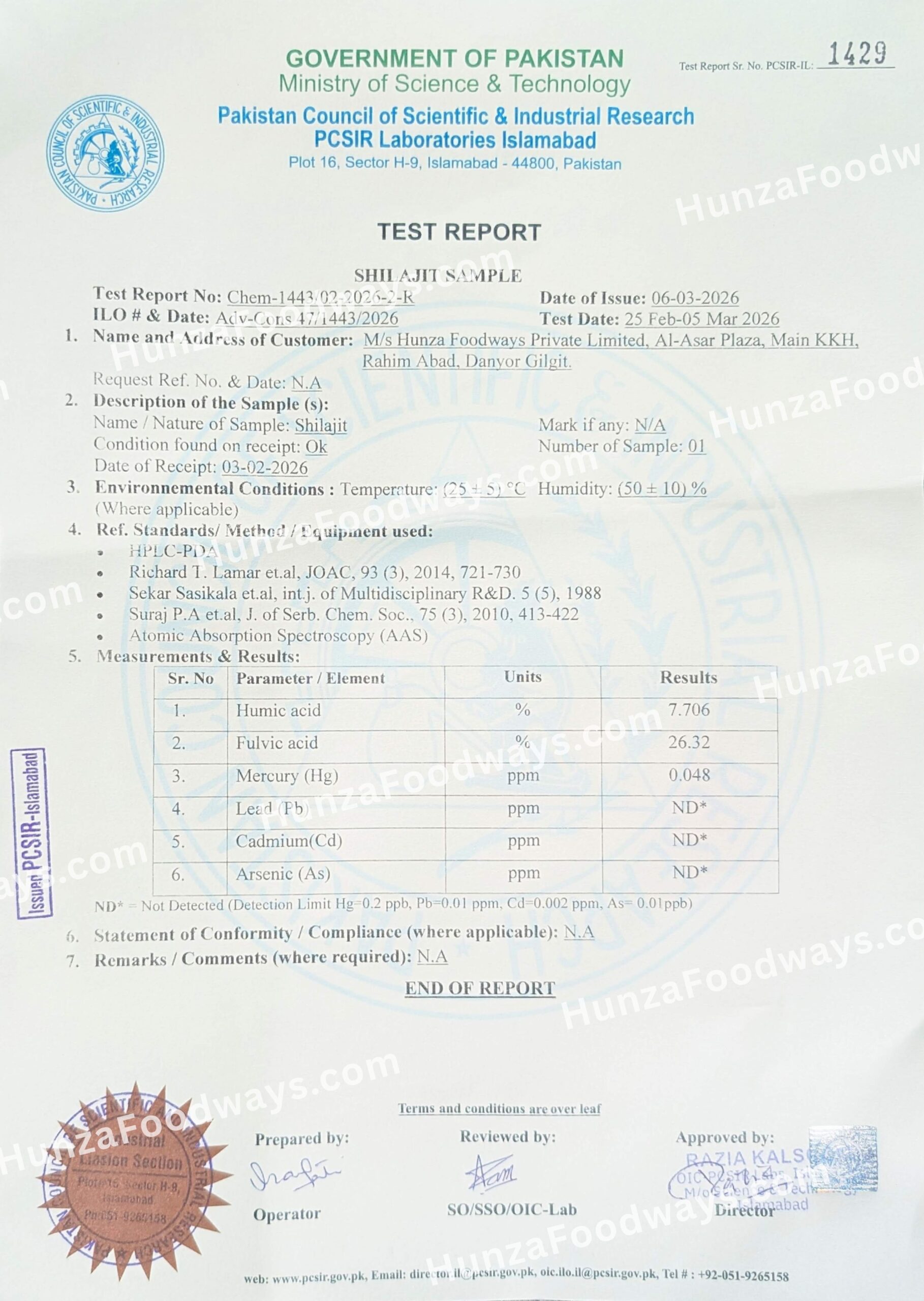
Detailed Analysis of Shilajit Heavy Metal safety report
We test every batch with an accredited government laboratory so you know exactly what you are getting.
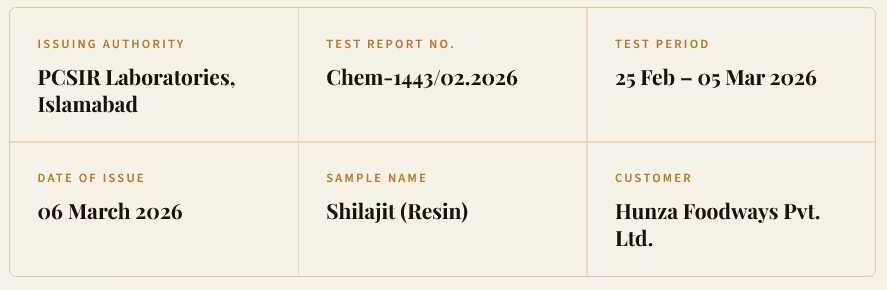
PCSIR Laboratories Islamabad · Test Report No. Chem-1443/02.2026
Why We Publish Our Lab Results
The shilajit market in Pakistan is full of products making claims with nothing to back them up. We felt the only honest way to sell original salajeet was to make the science public. Our sample was submitted to PCSIR Laboratories Islamabad, a government-accredited facility under the Ministry of Science and Technology, with no involvement from us in interpreting the results.
What you see below is what the lab found, nothing added, nothing removed. This is the shilajit lab report in Pakistan we are proud to put our name on.
Full Measurement Results
Six parameters were tested using HPLC-PDA and Atomic Absorption Spectroscopy (AAS), following internationally referenced methods.
Three of the most dangerous heavy metals were screened:
| Heavy Metal | Result | Status |
|---|---|---|
| Humic Acid | 7.706 % | ✅Present |
| Fulvic Acid | 26.32 % | ✅Present |
| Cadmium (As) | Not Detected (ND) | ✅ Undetectable |
| Mercury (Hg) | 0.048 ppm | ✅ Extremely Low |
| Lead (Pb) | Not Detected (ND) | ✅ Undetectable |
| Cadmium (Cd) | Not Detected (ND) | ✅ Undetectable |
ND = Not Detected. Detection limits: Hg < 0.2 ppb · Pb < 0.01 ppm · Cd < 0.002 ppm · As < 0.01 ppb
Fulvic Acid and Humic Acid: What the Results Mean
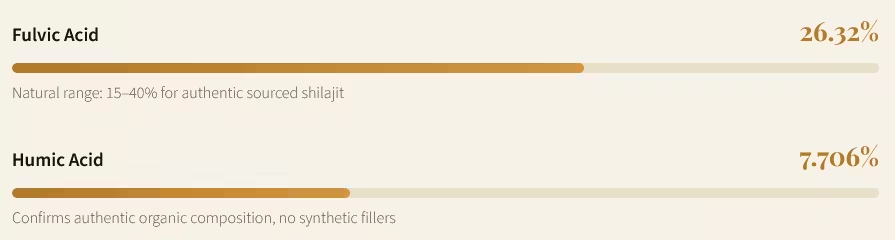
These two compounds are what separate real shilajit from imitations. Fulvic acid is the carrier molecule that helps your body absorb minerals at a cellular level. Humic acid supports detoxification and acts as a natural prebiotic in the gut. Together, they define the potency of any original shilajit.
Our batch tested at 26.32% fulvic acid and 7.706% humic acid. Fulvic acid content in authentic, unprocessed salajeet typically ranges between 15% and 40% depending on the rock source and altitude. Our result falls well within that natural window, with no synthetic additives needed to inflate the number.
Heavy Metal Results: What “Not Detected” Actually Means
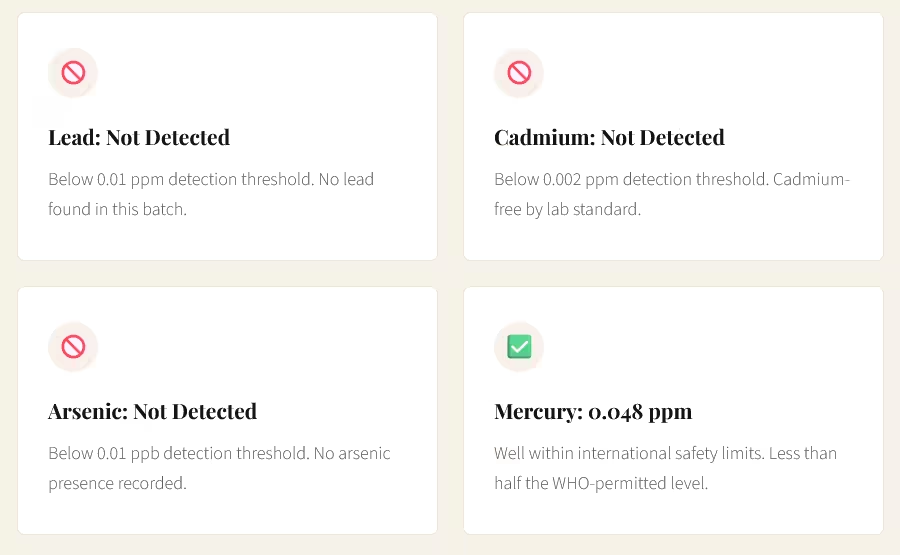
Shilajit forms over millions of years in compressed rock layers, which means it can also absorb whatever is present in its environment, including heavy metals. This is why testing matters. Our original salajeet lab report shows lead, cadmium, and arsenic all at “Not Detected” levels, meaning they fell below the instrument detection threshold entirely.
Mercury was detected at 0.048 ppm. For context, the WHO guideline for mercury in food supplements sits at 0.1 ppm, placing our result at less than half the permitted limit. All results were verified using Atomic Absorption Spectroscopy, a gold-standard method for trace metal analysis.
How the Testing Was Done
PCSIR Laboratories used a combination of HPLC-PDA (High Performance Liquid Chromatography with Photodiode Array Detection) to measure organic compounds like fulvic and humic acid, and Atomic Absorption Spectroscopy (AAS) to detect heavy metal concentrations. Both methods are referenced in peer-reviewed international research and are routinely used for food and supplement safety analysis.
The report was issued on 06 March 2026 under Test Report No. PCSIR-IL 1429. Environmental conditions during testing were maintained at 25°C ± 5°C with 50% ± 10% humidity.
We did not commission a private lab or select our own analysts. PCSIR is a government body, and their findings are independent of us.
Original Shilajit, Sourced from Hunza
Now that you have seen the report, see the product. Harvested from high-altitude Hunza Valley rock formations and tested before it reaches you.
One reply on “The Lab Report Behind Our Original Shilajit“